Sunday, July 22, 2012

MONDAY MORNING MISSION MEDITATION for the week of July 22, 2012


Catholic Charities. Providing Help. Creating Hope. 

VISION: Believing in the presence of God in our midst, we proclaim the sanctity of human life and the dignity of the person by sharing in the mission of Jesus given to the Church. To this end, Catholic Charities works with individuals, families, and communities to help them meet their needs, address their issues, eliminate oppression, and build a just and compassionate society.

MISSION: Rooted in the Mission of the Diocese of Youngstown "to minister to the people in the six counties of northeastern Ohio . . .(and) to the world community", we are called to provide service to people in need, to advocate for justice in social structures, and to call the entire Church and other people of good will to do the same.

GOALS: Catholic Charities is devoted to helping meet basic human needs, strengthening families, building communities and empowering low-income people. Working to reduce poverty in half by 2020.

KEY VALUE: Hospitality

WHAT WE DO: Organizing Love. "As a community, the Church must practise love. Love thus needs to be organized if it is to be an ordered service to the community" (Deus Caritas Est, par. 20) 


http://www.bridgebuilding.com/images/mi570x.jpg

On Sunday, (Sixteenth Sunday in Ordinary Time,  http://www.usccb.org/bible/readings/072212.cfm ) we read from the Gospel of  Mark about Jesus’ call to the disciples to stop and rest awhile.  Though they do find time to be alone with the Lord, the Gospel tells of the fact that “people were coming and going in great numbers, and they had no opportunity even to eat.”  Jesus recognizes the hunger and desire of these people to find life, abundant life.  Jesus’ heart is moved with pity (some say that the Greek word used for pity is related to the word for ‘throwing up’ or ‘wrenching’ from the ‘pit of one’s stomach’). In other words, Jesus found himself deeply moved by the needs and aspirations of the people always running to be touched by Him and His disciples.  They lacked a shepherd to provide that care.  Jesus’ Presence announces that God is among His people as the true and good shepherd.


In Catholic Charities http://www.ccdoy.org , we see persons and families “coming and going in great numbers” to our agencies seeking a human touch of compassion and help.  Oftentimes staff are not even able to get their lunch so that the needs of others may be served.  That is truly servant leadership in action -- just like a shepherd would do to protect and care for his/her flock.  As a ministry of the Bishop, we continue that healing presence in the world.  We see each person as an unique person made in God’s image.  We are honored to be a place where persons and families and even communities can come to us for assistance infused with the Presence of God.  Catholic Charities also recognizes that its staff also need time for renewal, reflection and regeneration just like the disciples along with Jesus.  We know that the Eucharist  http://www.vatican.va/holy_father/benedict_xvi/apost_exhortations/documents/hf_ben-xvi_exh_20070222_sacramentum-caritatis_en.html is a place to find such deep love and hope.  Catholic Charities aims to be that place of welcome and joy and compassion that Jesus’ called His disciples to do as the continue to spread the Good News of God’s abundant love.


Reflection from Church Documents and Official Statements

Forming Consciences for Faithful Citizenship - Part I - The U.S. Bishops’ Reflection On Catholic Teaching And Political Life

http://www.usccb.org/images/USCCB.gif

How Does the Church Help the Catholic Faithful to Speak About Political and Social Questions?

What Does the Church Say About Catholic Social Teaching in the Public Square?—Seven Key Themes

40. The consistent ethic of life provides a moral framework for principled Catholic engagement in political life and, rightly understood, neither treats all issues as morally equivalent nor reduces Catholic teaching to one or two issues. It anchors the Catholic commitment to defend human life, from conception until natural death, in the fundamental moral obligation to respect the dignity of every person as a child of God. It unites us as a "people of life and for life" (Evangelium Vitae, no. 6) pledged to build what Pope John Paul II called a "culture of life" (Evangelium Vitae, no. 77). This culture of life begins with the preeminent obligation to protect innocent life from direct attack and extends to defending life whenever it is threatened or diminished.

41. Catholic voters should use the framework of Catholic teaching to examine candidates' positions on issues affecting human life and dignity as well as issues of justice and peace, and they should consider candidates' integrity, philosophy, and performance. It is important for all citizens "to see beyond party politics, to analyze campaign rhetoric critically, and to choose their political leaders according to principle, not party affiliation or mere self-interest" (Living the Gospel of Life, no. 33).

42. As Catholics we are not single-issue voters. A candidate's position on a single issue is not sufficient to guarantee a voter's support. Yet a candidate's position on a single issue that involves an intrinsic evil, such as support for legal abortion or the promotion of racism, may legitimately lead a voter to disqualify a candidate from receiving support.

43. As noted previously, the Catholic approach to faithful citizenship rests on moral principles found in Scripture and Catholic moral and social teaching as well as in the hearts of all people of good will. We now present central and enduring themes of the Catholic social tradition that can provide a moral framework for decisions in public life.


Some important date(s) this week:
http://www.americancatholic.org/Features/Saints/ByDate.aspx

See website for biographies of Saints and Blessed celebrated this week.


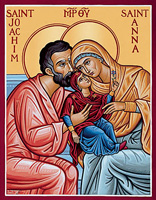
THURSDAY, JULY 26.   Sts. Joachim and Anne
http://www.reflectionsofaparalytic.com/images/st.joachimandanne.jpg
In the Scriptures, Matthew and Luke furnish a legal family history of Jesus, tracing ancestry to show that Jesus is the culmination of great promises. Not only is his mother’s family neglected, we also know nothing factual about them except that they existed. Even the names Joachim and Anne come from a legendary source written more than a century after Jesus died.
The heroism and holiness of these people, however, is inferred from the whole family atmosphere around Mary in the Scriptures. Whether we rely on the legends about Mary’s childhood or make guesses from the information in the Bible, we see in her a fulfillment of many generations of prayerful persons, herself steeped in the religious traditions of her people.
The strong character of Mary in making decisions, her continuous practice of prayer, her devotion to the laws of her faith, her steadiness at moments of crisis, and her devotion to her relatives—all indicate a close-knit, loving family that looked forward to the next generation even while retaining the best of the past.
Joachim and Anne—whether these are their real names or not—represent that entire quiet series of generations who faithfully perform their duties, practice their faith and establish an atmosphere for the coming of the Messiah, but remain obscure.


CHARITIES NEWSBYTES

August 26.  Help support HMHP Joanie Abdu Comprehensive Care Center through participating in the Panerathon.   http://doy.org/index.php?option=com_content&view=article&id=184%3Apanerathon&catid=45%3Astandalone&Itemid=95

Vatican announces theme for January 1, 2013 World Day of Peace Message:  Blessed are the Peacemakers  http://www.vis.va/vissolr/index.php?vi=all&dl=9e0a3f5e-ca19-460a-94b2-500400e08786&dl_t=text/xml&dl_a=y&ul=1&ev=1


 PAPAL INTENTIONS:   July 2012
   
    General Intention: Work Security. That everyone may have work in safe and secure conditions.
   
    Missionary Intention: Christian Volunteers. That Christian volunteers in mission territories may witness to the love of Christ. 

Corporal Works of Mercy:  The seven practices of charity toward our neighbor

  1. Feed the hungry
  2. Give drink to the thirsty
  3. Clothe the naked
  4. Shelter the homeless
  5. Visit the sick
  6. Visit those in prison
  7. Bury the dead


Note: Please consider joining our
FACEBOOK CAUSE http://apps.facebook.com/causes/106889 
FACEBOOK GROUP https://www.facebook.com/pages/Catholic-Charities-Diocese-of-Youngstown/138817639487339
TWITTER account, CCDOY, http://twitter.com/CCDOY
for current updates and calls to action that we can all use. 

See our website at www.catholiccharitiesyoungstown.org for links to the our ministries and services.    
For more information on Catholic Social Doctrine and its connection to our ministries, visit my blog at:  http://corbinchurchthinking.blogspot.com/
 

Monday, July 16, 2012

BLESSED are the PEACEMAKERS: Pope Benedict XVI's 2013 World Day of Peace Message

BLESSED ARE THE PEACEMAKERS

Vatican City, 16 July 2012 (VIS) - "Blessed are the peacemakers" is the theme chosen by the Holy Father for the forty-sixth World Day of Peace, which will fall on 1 January 2013, according to a communique released today by the Pontifical Council for Justice and Peace. "The annual Message of the Pope, in the complexity of the present time, will encourage everyone to take responsibility with regard to peace-building", the English-language communique reads.

"The Message will embrace, therefore, the fullness and diversity of the concept of peace, starting from the human being: inner peace and outer peace; then, highlighting the anthropological emergency, the nature and incidence of nihilism; and, at the same time, fundamental rights, in the first place freedom of conscience, freedom of expression, freedom of religion. The Message will offer, as well, an ethical reflection on some measures the world is going to take to contain the financial and economic crisis, the educational crisis, the crisis of the institutions and politics, which is also - in many cases - a worrying crisis of democracy.
"The Message will also look at the fifteth Anniversary of Vatican Council II and of the Encyclical Letter by Pope John XXIII, 'Pacem in Terris', according to which the primacy is always for human dignity and freedom, for the building of an earthly city to the service of every person, without any discrimination, and directed to the common good which is based on justice and true peace.

"'Blessed are the peacemakers' will be the eighth Message of Pope Benedict XVI for the Celebration of the World Day of Peace. Following are the titles of the previous ones: 'In Truth, Peace' (2006), 'The Human Person, Heart of Peace' (2007), 'The Human Family, a Community of Peace' (2008), 'Fighting Poverty to Build Peace' (2009), 'If you want to cultivate peace, protect creation' (2010), 'Religious Freedom, the path to peace' (2011), 'Educating young people in justice and peace' (2012)".

Sunday, July 15, 2012

MONDAY MORNING MISSION MEDITATION for the week of July 15, 2012


Catholic Charities. Providing Help. Creating Hope. 

VISION: Believing in the presence of God in our midst, we proclaim the sanctity of human life and the dignity of the person by sharing in the mission of Jesus given to the Church. To this end, Catholic Charities works with individuals, families, and communities to help them meet their needs, address their issues, eliminate oppression, and build a just and compassionate society.

MISSION: Rooted in the Mission of the Diocese of Youngstown "to minister to the people in the six counties of northeastern Ohio . . .(and) to the world community", we are called to provide service to people in need, to advocate for justice in social structures, and to call the entire Church and other people of good will to do the same.

GOALS: Catholic Charities is devoted to helping meet basic human needs, strengthening families, building communities and empowering low-income people. Working to reduce poverty in half by 2020.

KEY VALUE: Hospitality

WHAT WE DO: Organizing Love. "As a community, the Church must practise love. Love thus needs to be organized if it is to be an ordered service to the community" (Deus Caritas Est, par. 20) 


http://farm7.staticflickr.com/6030/5960184415_0fe6afcfa7.jpg

On Sunday, (Fifteenth Sunday in Ordinary Time,   http://usccb.org/bible/readings/071512.cfm ) we read from the Gospel of  Mark regarding Jesus’ call to his disciples to go out into the world to proclaim the Good News.  They are told to take only the necessary items on their journey, and to work with persons in each community who want to help share that Good News.  We further learn that these sent disciples are healing and curing many people, as part of their encounter with the living Presence.  In the first reading from Hosea, the prophet, we hear how he was chosen from humble beginnings and followed God’s call to proclaim a new time -- God’s Presence among His chosen ones.


In Catholic Charities http://www.ccdoy.org , we continue that tradition of going into the lives of persons, families and communities offering Good News of welcome and hope.  Many of our Catholic Charities’ workers encounter people in need in our offices and in unlikely places: from early morning events or meetings at a parish or coffee shop, to a later evening meetings at a restaurant or under a bridge.   That spirit of discipleship permeates the work and heart of Catholic Charities.  Thanks to the many gifts from generous donors to the Bishop’s Annual Appeal for Catholic Charities and Church   http://goo.gl/Ebuv9  we are able to provide help and create hope for many persons, families and communities that we serve.


Reflection from Church Documents and Official Statements

Forming Consciences for Faithful Citizenship - Part I - The U.S. Bishops’ Reflection On Catholic Teaching And Political Life

http://www.usccb.org/images/USCCB.gif

How Does the Church Help the Catholic Faithful to Speak About Political and Social Questions?

Making Moral Choices

34. Catholics often face difficult choices about how to vote. This is why it is so important to vote according to a well-formed conscience that perceives the proper relationship among moral goods. A Catholic cannot vote for a candidate who takes a position in favor of an intrinsic evil, such as abortion or racism, if the voter's intent is to support that position. In such cases a Catholic would be guilty of formal cooperation in grave evil. At the same time, a voter should not use a candidate's opposition to an intrinsic evil to justify indifference or inattentiveness to other important moral issues involving human life and dignity.

35. There may be times when a Catholic who rejects a candidate's unacceptable position may decide to vote for that candidate for other morally grave reasons. Voting in this way would be permissible only for truly grave moral reasons, not to advance narrow interests or partisan preferences or to ignore a fundamental moral evil.

36. When all candidates hold a position in favor of an intrinsic evil, the conscientious voter faces a dilemma. The voter may decide to take the extraordinary step of not voting for any candidate or, after careful deliberation, may decide to vote for the candidate deemed less likely to advance such a morally flawed position and more likely to pursue other authentic human goods.

37. In making these decisions, it is essential for Catholics to be guided by a well-formed conscience that recognizes that all issues do not carry the same moral weight and that the moral obligation to oppose intrinsically evil acts has a special claim on our consciences and our actions. These decisions should take into account a candidate's commitments, character, integrity, and ability to influence a given issue. In the end, this is a decision to be made by each Catholic guided by a conscience formed by Catholic moral teaching.

38. It is important to be clear that the political choices faced by citizens not only have an impact on general peace and prosperity but also may affect the individual's salvation. Similarly, the kinds of laws and policies supported by public officials affect their spiritual well-being. Pope Benedict XVI, in his recent reflection on the Eucharist as "the sacrament of charity," challenged all of us to adopt what he calls "a Eucharistic form of life." This means that the redeeming love we encounter in the Eucharist should shape our thoughts, our words, and our decisions, including those that pertain to the social order. The Holy Father called for "Eucharistic consistency" on the part of every member of the Church:

It is important to consider what the Synod Fathers described as eucharistic consistency, a quality which our lives are objectively called to embody. Worship pleasing to God can never be a purely private matter, without consequences for our relationships with others: it demands a public witness to our faith. Evidently, this is true for all the baptized, yet it is especially incumbent upon those who, by virtue of their social or political position, must make decisions regarding fundamental values, such as respect for human life, its defense from conception to natural death, the family built upon marriage between a man and a woman, the freedom to educate one's children and the promotion of the common good in all its forms. . . . (Sacramentum Caritatis, no. 83)

39. The Holy Father, in a particular way, called on Catholic politicians and legislators to recognize their grave responsibility in society to support laws shaped by these fundamental human values, and urged them to oppose laws and policies that violate life and dignity at any stage from conception to natural death. He affirmed the responsibility of bishops to teach these values consistently to all of their people.


Some important date(s) this week:
http://www.americancatholic.org/Features/Saints/ByDate.aspx

See website for biographies of Saints and Blessed celebrated this week.


Wednesday, July 18.  St. Camillus de Lellis.  (1550-1614).  

St. Camillus de Lellis (http://www.catholic.org/saints/saint.php?saint_id=265) was born at Bocchianico, Italy. He fought for the Venetians against the Turks, was addicted to gambling, and by 1574 was penniless in Naples. He became a Capuchin novice, but was unable to be professed because of a diseased leg he contracted while fighting the Turks. 

St Camillus de Lellis, St Peter's Basilica, Vatican City
He devoted himself to caring for the sick, and became director of St. Giacomo Hospital in Rome. He received permission from his confessor (St. Philip Neri) to be ordained and decided, with two companions, to found his own congregation, the Ministers of the Sick (the Camellians), dedicated to the care of the sick.

 They ministered to the sick of Holy Ghost Hospital in Rome, enlarged their facilities in 1585, founded a new house in Naples in 1588, and attended the plague-stricken aboard ships in Rome's harbor and in Rome. In 1591, the Congregation was made into an order to serve the sick by Pope Gregory XIV, and in 1591 and 1605, Camillus sent members of his order to minister to wounded troops inHungary and Croatia, the first field medical unit. 

Gravely ill for many years, he resigned as superior of the Order in 1607 and died in Rome on July 14, the year after he attended a General Chapter there. He was canonized in 1746, was declared patron of the sick, with St. John of God, by Pope Leo XIII, and patron of nurses and nursing groups by Pope Pius XI. His feast day is July 18th.


CHARITIES NEWSBYTES

August 26. Join our Diocese of Youngstown Team.   Help support HMHP Joanie Abdu Comprehensive Care Center through participating in the Panerathon.   http://doy.org/index.php?option=com_content&view=article&id=184%3Apanerathon&catid=45%3Astandalone&Itemid=95


 PAPAL INTENTIONS:   July 2012
   
    General Intention: Work Security. That everyone may have work in safe and secure conditions.
   
    Missionary Intention: Christian Volunteers. That Christian volunteers in mission territories may witness to the love of Christ. 


Corporal Works of Mercy:  The seven practices of charity toward our neighbor

  1. Feed the hungry
  2. Give drink to the thirsty
  3. Clothe the naked
  4. Shelter the homeless
  5. Visit the sick
  6. Visit those in prison
  7. Bury the dead


Note: Please consider joining our
FACEBOOK CAUSE http://apps.facebook.com/causes/106889 
FACEBOOK GROUP https://www.facebook.com/pages/Catholic-Charities-Diocese-of-Youngstown/138817639487339
TWITTER account, CCDOY, http://twitter.com/CCDOY
for current updates and calls to action that we can all use. 

See our website at www.catholiccharitiesyoungstown.org for links to the our ministries and services.    
For more information on Catholic Social Doctrine and its connection to our ministries, visit my blog at:  http://corbinchurchthinking.blogspot.com/